Understand Your Customers Better: A Practical Guide to Empathy Mapping
By EasyStore Philippines · 13th August, 2026
Table of Contents
The way people shop is changing. With more choices, more information and more ways to buy, customers are no longer simply asking, “What can you offer me?”
They’re asking, “What do I need, and can you solve my problem?”
For businesses, understanding that need is key. But customers don’t always tell you what they want directly.
That’s where an empathy map comes in. It helps you look at your business from your customer’s perspective — what they think, feel, see, hear, say and do — so you can better understand their needs and pain points.
What Is an Empathy Map?
An empathy map is a simple tool for putting yourself in your customer's shoes.
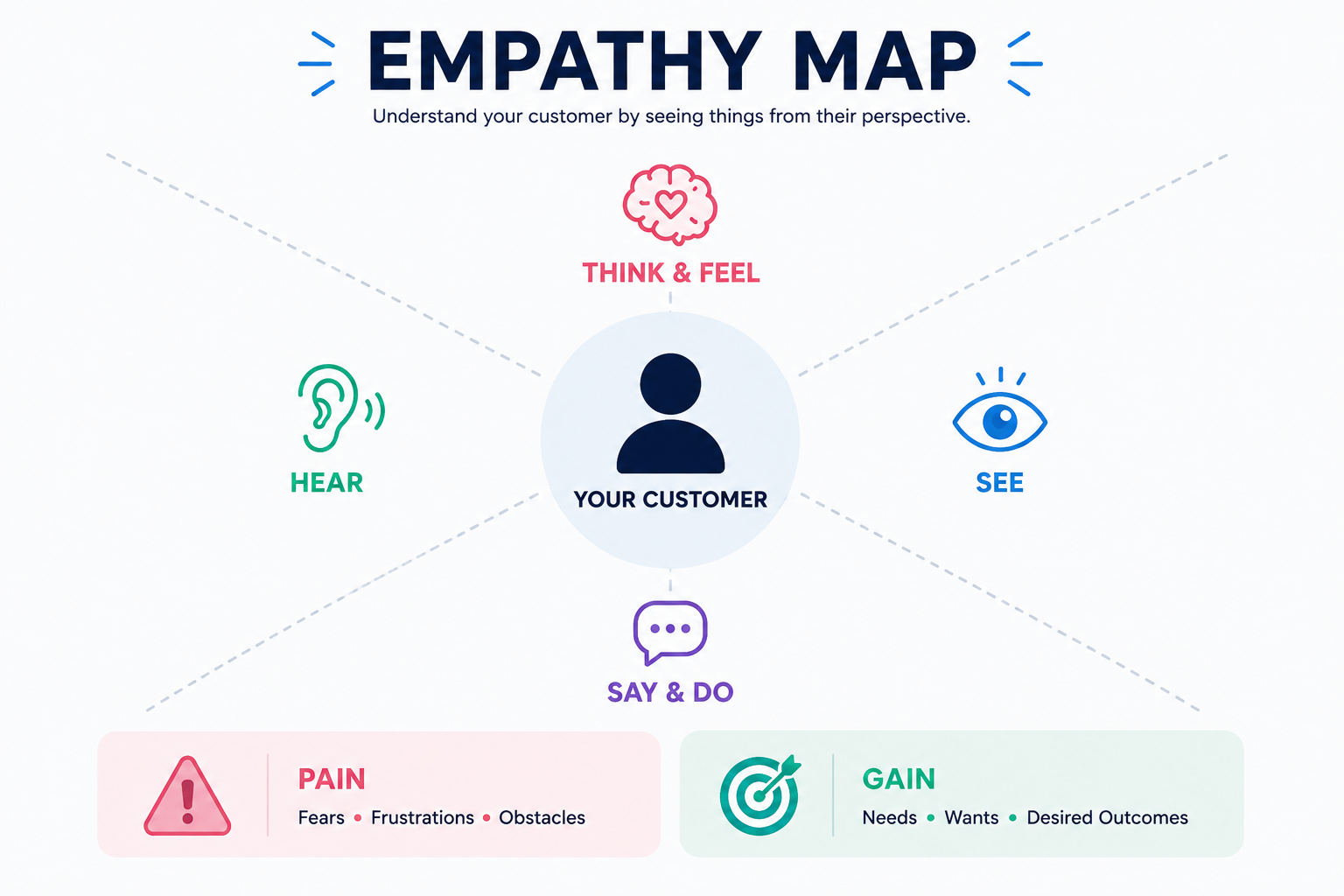
It looks at six key areas:
- Think & Feel — What is on your customer's mind?
- See — What do they see around them?
- Hear — Who or what influences them?
- Say & Do — What do they say and how do they behave?
- Pain Points — What frustrates or stops them?
- Gains — What do they want to achieve?
The goal isn't to guess what your customers want. It's to understand their experience so you can make better business decisions.
1. What Does Your Customer Think and Feel?
Think about what's going through your customer's mind before they buy.
Are they worried about the price?
Do they trust the seller?
Are they unsure whether the product will work?
For example, someone looking at a skincare product might think:
“Will this work for my skin?”
“Is this seller trustworthy?”
“Is it worth the price?”
These concerns may not appear in your sales data, but they can strongly influence a buying decision.
Look at your customer reviews, comments and messages to find out what customers are actually thinking about.
2. What Does Your Customer See?
Customers don't see your business in isolation.
They see your products alongside:
- Competitors
- Social media posts
- Reviews
- Promotions
- Marketplace listings
- Influencer content
- Other products
Ask yourself:
What does my customer see when they compare me with other businesses?
If your product costs more than a competitor's, for example, is the difference in quality or value clear?
If customers can't see the difference, they may simply choose the cheaper option.
3. What Does Your Customer Hear?
Customers are influenced by more than your own marketing.
They may hear recommendations from friends, reviews from other buyers, influencers, social media comments or even conversations in online communities.
Ask:
Who influences my customer's decision?
Understanding these influences can help you create more relevant content — from customer testimonials to FAQs and product demonstrations.

4. What Does Your Customer Say and Do?
Now look at what customers actually do.
Do they:
- Ask about price?
- Check reviews?
- Compare products?
- Ask about shipping?
- Save your post and come back later?
- Visit your website before buying?
For example, a customer may comment:
“Looks good!”
But then spend several days comparing prices and reading reviews before purchasing.
What customers say and what they do may be different. Both can give you valuable insights.
5. What Are Your Customer's Pain Points?
A pain point is a problem, frustration or concern that makes buying more difficult.
It could be:
- High shipping fees
- Slow replies
- Unclear product information
- Limited payment options
- Lack of reviews
- Complicated ordering
- Concerns about product quality
- Difficult checkout
Sometimes, businesses focus so much on promoting their product that they overlook these small points of friction.
For example, your customer may love your product but still ask:
“How much is shipping?”
If that question keeps coming up, it may be something your marketing or store needs to address more clearly.
6. What Does Your Customer Want to Gain?
Finally, think about what your customer hopes to achieve.
They may want:
- Better value
- Convenience
- Faster delivery
- A solution to a problem
- More confidence in their purchase
- Better service
- A smoother shopping experience
The desired outcome isn't always about the product itself.
A customer buying skincare may want clearer, healthier-looking skin.
A customer buying a gift may simply want to make someone happy.
Understanding the real outcome your customer wants can help you communicate your value more effectively.
You know what your customers need. Now give them a shopping experience that makes buying easier.
A Simple Example
Let's say you sell beauty products online.
Your customer discovers you through social media.
Here's what their empathy map might look like:
| Customer Insight | |
| Think & Feel | “Will this really work?” “Can I trust this seller?” |
| See | Product videos, reviews, competitors and promotions |
| Hear | Recommendations from friends, influencers and other buyers |
| Say & Do | Asks about price, checks reviews and compares products |
| Pain | Unclear information, shipping costs and uncertainty |
| Gain | Confidence, convenience, good value and an easy purchase |
Now you have a clearer picture of what your customer needs.
Instead of simply posting another product promotion, you could create content that answers their concerns:
Worried about whether it works?
→ Show how to use it and share customer results.
Not sure which product to choose?
→ Create a simple comparison guide.
Concerned about shipping?
→ Make shipping fees and delivery information clear.
Need more confidence?
→ Highlight genuine customer reviews and testimonials.
This is where empathy mapping becomes useful: it helps turn customer insights into action.
From Insights to Action
An empathy map is only useful when you turn what you learn into action.
Use your customer insights to ask:
- What should we improve?
- What questions should our content answer?
- What friction can we remove from the buying process?
- What can we do to make customers feel more confident about buying?
You can use customer reviews, comments, enquiries and other feedback to validate your assumptions. AI can also help you spot recurring themes when you have a large amount of customer feedback to analyse.
The goal isn't to collect more information. It's to understand what matters most to your customers — and act on it.
The Bottom Line
You don't always need more products, promotions or content.
Sometimes, the better move is to understand your customer first.
An empathy map gives you a simple starting point to see your business from their perspective — and turn those insights into better marketing and better customer experiences.
Turn what you’ve learned about your customers into a smoother shopping experience with EasyStore.